Telemetry and data collection
Percona Server for MySQL includes two telemetry systems. Each system is optional.
-
Installation-time telemetry runs once at package install or container startup.
-
Continuous telemetry uses a database (DB) component and the
percona-telemetry-agenthost process. The pair collects metrics and sends them on a daily schedule.
You control whether to share telemetry data. Disable either system, or both, when you do not want anonymous usage data sent to Percona.
Percona does not collect personal information. All telemetry data is anonymous. See the Percona Privacy policy .
Packages, compressed archives (tarballs), and Docker images include telemetry. Tarball deployments require the telemetry agent and a writable directory under /usr/local/percona/telemetry.
Telemetry overview
Telemetry reports anonymous deployment and usage metrics to Percona. Percona uses the data to prioritize fixes and feature work. Telemetry does not include database names, credentials, or user data.
Installation-time telemetry
Installation-time telemetry runs once. The process collects host and version metadata during package installation or container startup. The process does not run again after installation completes.
Installation-time telemetry file example
The following JSON shows a typical installation-time payload:
[{"id" : "c416c3ee-48cd-471c-9733-37c2886f8231",
"product_family" : "PRODUCT_FAMILY_PS",
"instanceId" : "6aef422e-56a7-4530-af9d-94cc02198343",
"createTime" : "2026-03-26T15:43:18Z",
"metrics":
[{"key" : "deployment","value" : "PACKAGE"},
{"key" : "pillar_version","value" : "8.4.11-11"},
{"key" : "OS","value" : "Oracle Linux Server 10"},
{"key" : "hardware_arch","value" : "x86_64 x86_64"}]}]
Disable installation-time telemetry
Installation-time telemetry is enabled by default. Set the environment variable PERCONA_TELEMETRY_DISABLE=1 before you install packages or start a container. The variable does not disable continuous telemetry. Installation-time telemetry uses PERCONA_TELEMETRY_DISABLE; continuous telemetry uses the server option percona_telemetry_disable.
sudo PERCONA_TELEMETRY_DISABLE=1 apt install percona-server-server
sudo PERCONA_TELEMETRY_DISABLE=1 dnf install percona-server-server
docker run -d -e MYSQL_ROOT_PASSWORD=test1234# -e PERCONA_TELEMETRY_DISABLE=1 --name=percona-server percona/percona-server:8.4
Continuous telemetry
Continuous telemetry combines a Percona telemetry DB component with the percona-telemetry-agent service. The component writes metrics files on disk. The agent uploads the files to the Percona telemetry service. The agent waits 24 hours after startup before the first upload attempt.
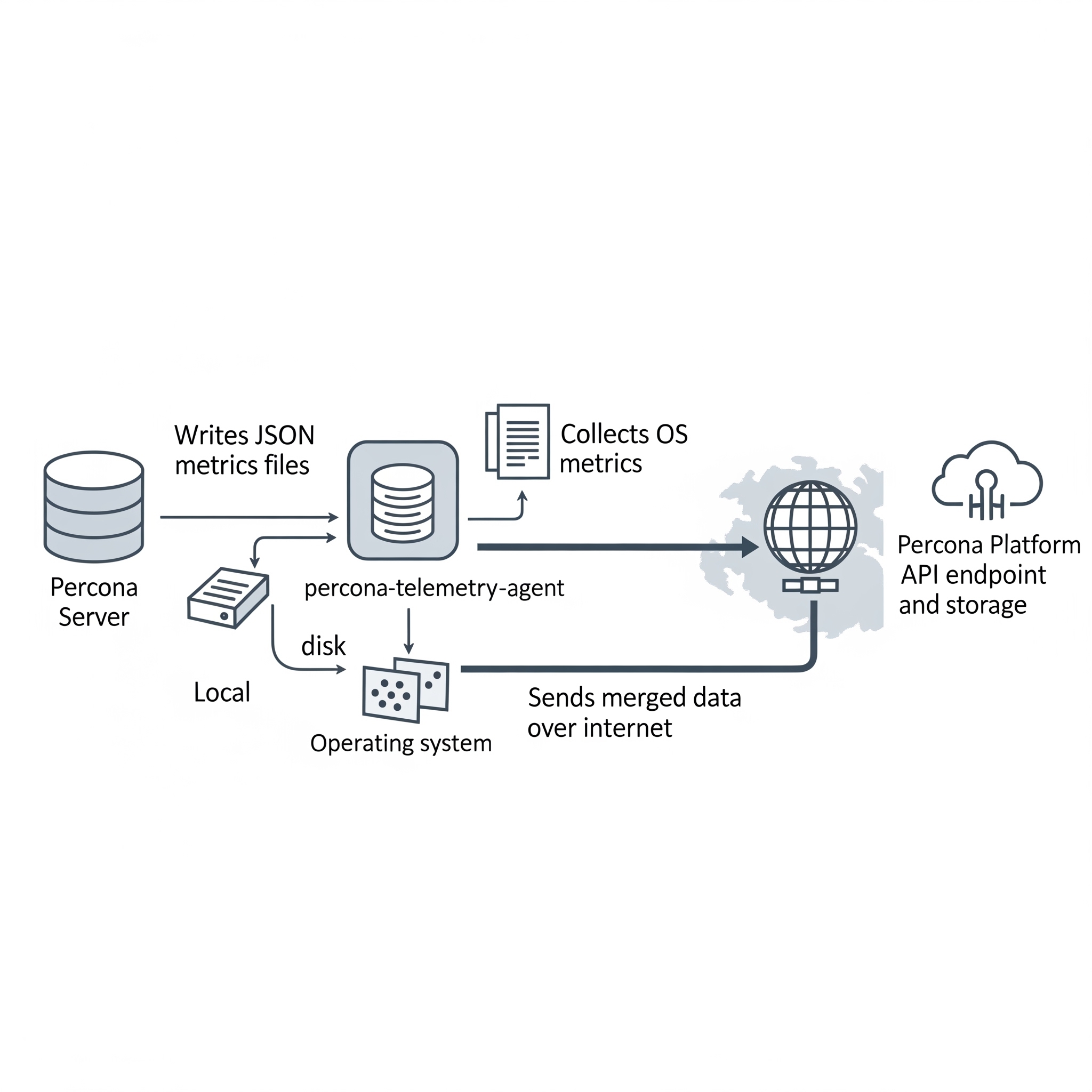
Elements of the continuous telemetry system
The continuous telemetry system includes these host-side and platform-side pieces:
| Piece | Role |
|---|---|
| Percona telemetry DB component | Collects metrics inside the server and writes a metrics file on disk |
| Metrics file | JavaScript Object Notation (JSON) file on the host that stores collected metrics |
Telemetry agent (percona-telemetry-agent) |
Host process that collects operating system metrics, reads metrics files, merges payloads, and queries the package manager for Percona packages |
| Telemetry service | Application programming interface (API) endpoint that receives telemetry payloads |
| Telemetry storage | Long-term storage for telemetry data on the Percona platform |
Overview of the DB component
Percona Server for MySQL installs the telemetry DB component by default. The component registers as file://component_percona_telemetry.
The DB component performs these tasks:
-
Collects database metrics once per day
-
Writes a timestamped
.jsonfile under the telemetry directory -
Retains metrics files for seven days and deletes older files before creating a new file
The DB component does not collect these data types:
-
Database names
-
User names or credentials
-
Application or user data
Locations of metrics files and telemetry history
The telemetry root path on the host is /usr/local/percona/telemetry.
Product-specific directories use the following paths under the root:
| Product | Path |
|---|---|
| Percona Server for MySQL | ${telemetry root}/ps/ |
Percona Server for MongoDB (mongod) |
${telemetry root}/psmdb/ |
Percona Server for MongoDB (mongos) |
${telemetry root}/psmdbs/ |
| Percona XtraDB Cluster | ${telemetry root}/pxc/ |
| PostgreSQL products | ${telemetry root}/pg/ |
After a successful upload, the agent stores a copy under ${telemetry root}/history/.
Metrics file format
Metrics files use JSON. Percona may extend the schema in future releases. Production files can list many active_plugins entries. The following example shows the core fields:
{
  "db_instance_id": "e83c568c-e140-11ee-8320-7e207666b18a",
  "pillar_version": "8.4.11-11",
  "active_plugins": [
    "binlog",
    "caching_sha2_password",
    "InnoDB",
    "PERFORMANCE_SCHEMA"
  ],
  "active_components": [
    "file://component_percona_telemetry"
  ],
  "uptime": "6185",
  "databases_count": "7",
  "databases_size": "33149",
  "se_engines_in_use": [
    "InnoDB"
  ],
  "replication_info": {
    "is_semisync_source": "1",
    "is_replica": "1"
  }
}
Percona telemetry agent
The percona-telemetry-agent process runs on the database host. The agent manages JSON files under the telemetry root path.
The agent follows the following schedule:
-
Log file path:
/var/log/percona/telemetry-agent.log -
First 24 hours: no collection and no upload
-
After 24 hours: one upload attempt per day, with up to five retries on failure
-
After a successful upload: copy the file to
history/and delete the source file from the DB component directory -
When the telemetry directory has no Percona product files: send nothing
Network access and corporate proxies
Continuous telemetry uploads use Hypertext Transfer Protocol Secure (HTTPS). The default endpoint is:
https://check.percona.com/v1/telemetry/GenericReport
Firewall teams must allow outbound HTTPS on port 443 to check.percona.com. Override the endpoint with PERCONA_TELEMETRY_URL or the --telemetry.url argument for percona-telemetry-agent.
To send traffic through a corporate proxy, add environment variables in a systemd drop-in for percona-telemetry-agent.service:
[Service]
Environment="HTTPS_PROXY=http://PROXY_HOST:PROXY_PORT"
Environment="NO_PROXY=localhost,127.0.0.1"
Apply the drop-in and restart the agent:
sudo systemctl edit percona-telemetry-agent
sudo systemctl daemon-reload
sudo systemctl restart percona-telemetry-agent
Replace PROXY_HOST and PROXY_PORT with your proxy hostname and port.
Air-gapped and isolated networks
Upload failures trigger five retries. The agent then waits until the next daily check. Unsent metrics files remain on disk until an upload succeeds.
Disk use stays bounded in isolated networks:
-
The DB component retains seven days of metrics files and prunes older files before each daily write, regardless of upload status
-
The agent prunes archived history on a seven-day interval (
PERCONA_TELEMETRY_HISTORY_KEEP_INTERVAL, default 604800 seconds)
Disable continuous telemetry to stop new metrics files and outbound uploads.
Telemetry agent configuration
The agent reads these environment variables at startup. Restart the service after you change a value.
| Variable | Default | Description |
|---|---|---|
PERCONA_TELEMETRY_ROOT_PATH |
/usr/local/percona/telemetry |
Root directory for metrics and history files |
PERCONA_TELEMETRY_CHECK_INTERVAL |
86400 |
Seconds between upload checks |
PERCONA_TELEMETRY_RESEND_INTERVAL |
60 |
Seconds between retry attempts after a failed upload |
PERCONA_TELEMETRY_HISTORY_KEEP_INTERVAL |
604800 |
Seconds between history directory cleanup runs |
PERCONA_TELEMETRY_URL |
https://check.percona.com/v1/telemetry/GenericReport |
Upload endpoint URL |
Telemetry agent payload example
{
  "reports": [
    {
      "id": "B5BDC47B-B717-4EF5-AEDF-41A17C9C18BB",
      "createTime": "2026-03-26T15:44:54Z",
      "instanceId": "B5BDC47B-B717-4EF5-AEDF-41A17C9C18BA",
      "productFamily": "PRODUCT_FAMILY_PS",
      "metrics": [
        {
          "key": "OS",
          "value": "Ubuntu"
        },
        {
          "key": "pillar_version",
          "value": "8.4.11-11"
        }
      ]
    }
  ]
}
Telemetry agent payload fields
Each report object uses these fields:
| Field | Description |
|---|---|
id |
Random universally unique identifier (UUID) version 4 for the request |
createTime |
Request timestamp |
instanceId |
Host ID from the metrics file, /usr/local/percona/telemetry_uuid, or a generated UUID version 4 when the file is absent |
productFamily |
Product family derived from the metrics file path, such as PRODUCT_FAMILY_PS |
metrics |
Key and value pairs from the metrics file |
Operating system metrics in each upload
Each upload can include these operating system keys:
| Key | Description |
|---|---|
OS |
Operating system name |
hardware_arch |
CPU architecture |
deployment |
Deployment method, such as PACKAGE or DOCKER |
installed_packages |
Installed Percona packages with name, version, and repository when available |
The agent queries the local package manager. The query matches only package names that fit Percona patterns, including percona-*, Percona-*, proxysql*, pmm, etcd*, haproxy, patroni, pg*, postgis, and wal2json. The agent does not report non-Percona packages.
Disable continuous telemetry
Continuous telemetry is enabled by default. Complete the steps in the following order.
Restart required
Steps 1 and 3 require a server or service restart. Plan a maintenance window before you change telemetry settings in production.
-
Add the server option
percona_telemetry_disable=1under[mysqld]inmy.cnf, or in an included option file. Restart the server. The server option prevents the telemetry component from loading after restart. Do not rely onUNINSTALL COMPONENTalone. A restart withoutpercona_telemetry_disable=1can reload telemetry. -
Run
UNINSTALL COMPONENT "file://component_percona_telemetry";to stop metrics file generation. -
Stop and disable
percona-telemetry-agentas described in Disable the telemetry agent.
These steps disable continuous telemetry only. For install-time opt-out, see Disable installation-time telemetry.
Disable the telemetry agent
Stopping the agent blocks uploads. The DB component continues to write metrics files until you uninstall the component.
Run both commands for a permanent disable:
sudo systemctl stop percona-telemetry-agent
sudo systemctl disable percona-telemetry-agent
systemctl stop ends the running agent process. systemctl disable prevents the agent from starting at boot.
To pause the agent until the next host reboot, run sudo systemctl stop percona-telemetry-agent only. Do not run disable when you plan to re-enable the agent after reboot.
Agent dependencies and removal
The telemetry agent is a mandatory package dependency for Percona Server for MySQL. Review package dependencies before you remove the agent.
Package manager behavior differs:
-
DNF can remove the agent when you remove the last dependent package. Removing the agent alone can remove Percona Server for MySQL when dependencies require the agent.
-
APT may keep the agent after you remove only the server package. Use
apt autoremovewhen appropriate. Removing the agent without checking dependencies can affect the server package.
Verify continuous telemetry is disabled
Run these checks from the MySQL client and on the host.
Confirm the telemetry component is absent:
SELECT component_urn
FROM mysql.component
WHERE component_urn LIKE '%telemetry%';
Expected output when telemetry is disabled
Empty set (0.00 sec)
Confirm the disable option is set:
SHOW GLOBAL VARIABLES LIKE 'percona_telemetry_disable';
Expected output when telemetry is disabled
+---------------------------+-------+
| Variable_name             | Value |
+---------------------------+-------+
| percona_telemetry_disable | ON    |
+---------------------------+-------+
1 row in set (0.00 sec)
Confirm the agent is inactive on the host:
systemctl is-enabled percona-telemetry-agent
systemctl is-active percona-telemetry-agent
After a permanent disable, is-enabled returns disabled and is-active returns inactive.
Disable the DB component
The DB telemetry component can write metrics files for seven days while the agent is stopped. Uninstall the component after you set percona_telemetry_disable=1 and restart the server. See the ordered steps in Disable continuous telemetry.
UNINSTALL COMPONENT "file://component_percona_telemetry";
Add percona_telemetry_disable=1 to my.cnf when the line is missing, then restart:
[mysqld]
percona_telemetry_disable=1